Verdict: Evaluating the best shipping and fulfillment software for ecommerce in 2026 comes down to three questions: whether you want in-house or outsourced fulfillment, how many orders you ship per month, and which geographic markets you serve. ShipBob leads for brands ready to hand off warehousing entirely; ShipStation is the strongest pick for SMBs managing their own shipping at accessible cost. International-first sellers should start with Shippo, and Shopify-only brands at low-to-mid volume often need nothing beyond Shopify Shipping.
What to Look for in Ecommerce Shipping Software
The best shipping and fulfillment software for ecommerce in 2026 is not a single product. It is a category of tools that solve fundamentally different problems depending on your order volume, geographic footprint, and whether you want to handle fulfillment in-house or hand it to a third-party logistics provider. Buyers who skip that framing end up paying for warehouse management they cannot use or locked into a label-printing tool that cannot scale past 500 orders a month.
At minimum, a credible shipping platform delivers four things: flexible order management including batching, filtering, and combining orders; shipping rate comparison across multiple carriers; automation for labeling, tracking, and notifications; and solid integrations with your cart, marketplace, or ERP. Sellers shipping internationally add a fifth requirement: reliable customs form generation and duty documentation. Warehouse operators add a sixth: offline resilience and strong device performance on the warehouse floor, since poor integration with WMS software directly undermines staff productivity regardless of how impressive a platform’s feature list looks in a demo.
Integration quality is underrated by most buyers at the research stage. A platform promising 50 carrier connections but breaking your Shopify sync every other week delivers less real value than a narrower tool that runs without friction. Industry sources in 2026 are consistent on this point: poor integration quality often outweighs any theoretical feature advantage. Prioritize what connects cleanly to your existing stack over what looks best in a comparison table, including this one.
Platform-by-Platform Breakdown: SMBs and Mid-Market Stores
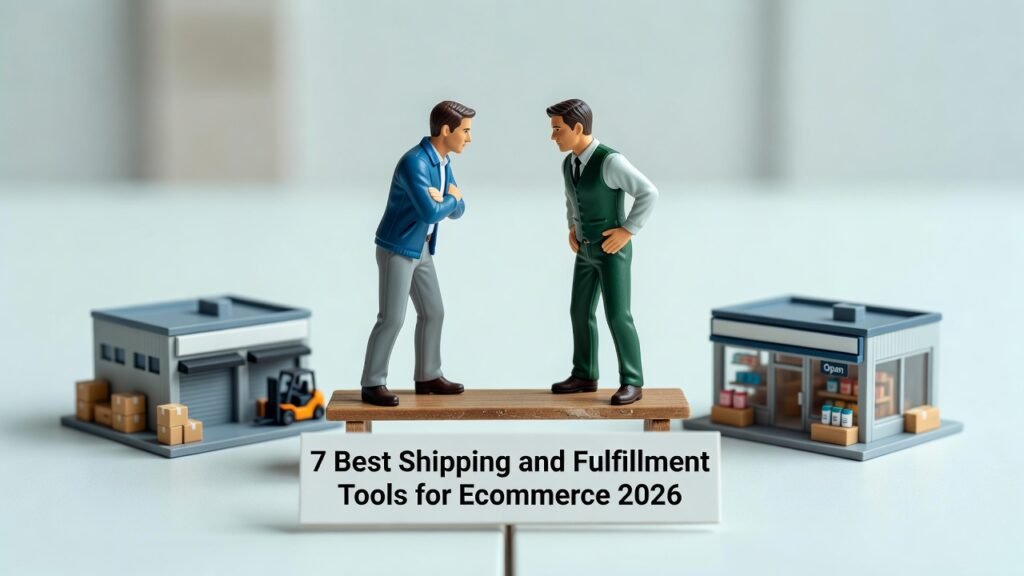
When evaluating the best shipping and fulfillment software for ecommerce in 2026, the first decision is whether you want pure software or a software-plus-warehouse service. ShipBob occupies its own category because it bundles a shipping and fulfillment platform with a physical warehouse network. Merchants using ShipBob hand off storage, pick-and-pack, and last-mile delivery entirely, which suits brands that want to remove fulfillment from their operational plate. ShipStation targets a different buyer: the independent store owner who fulfills orders in-house and needs affordable label printing, multi-carrier rate comparison, and broad integrations with platforms including Shopify, WooCommerce, Amazon, and eBay. More on ShipBob’s fulfillment network at shipbob.com and ShipStation’s integration library at shipstation.com.
ShippingEasy stands out for budget-constrained brands. Its free plan covers the core shipping workflow, including labels, tracking, and basic automation, making it the lowest-risk entry point for early-stage stores that cannot justify a monthly software fee. Shippo takes a different angle, prioritizing breadth of global carrier coverage over warehouse integration. For sellers shipping to customers across multiple countries who need customs forms, duty documentation, and local last-mile carrier access in Europe, Latin America, or Asia, Shippo is the most purpose-built choice among these four. Its carrier coverage can be reviewed at goshippo.com.
Buyer Persona: The bootstrapped DTC founder shipping 200-400 orders per month from a single location. This buyer needs multi-carrier rate comparison and integrations with Shopify, Amazon, and eBay without paying for warehouse services or enterprise features they will not use. ShipStation fits this profile because it offers the widest cart and marketplace integration library at an accessible monthly price, without requiring 3PL outsourcing or a lengthy onboarding process.
Ordoro closes out the mid-market tier for high-growth operations. It handles advanced shipping, inventory tracking, and multi-channel order orchestration with considerably more depth than ShipStation or ShippingEasy. The trade-off is price and complexity: industry sources describe Ordoro as powerful but expensive, with a steep learning curve that makes it a poor starting point for early-stage stores. It suits merchants who have outgrown simpler tools and need automation that spans carriers, warehouse locations, and multiple sales channels at the same time.
Shopify Stores, European Sellers, and Specialty Use Cases
Shopify Shipping is the default recommendation for any merchant whose entire operation runs on a single Shopify store. It offers strong carrier discounts natively, the shipping workflow lives inside the Shopify admin, and there is no additional monthly software cost. The limitation is real and compounds over time: it does not work outside Shopify, and any brand adding a second sales channel or planning a platform migration will outgrow it quickly. For Shopify-only brands at low-to-mid volume, the simplicity and cost advantage frequently justify that tradeoff.
European and Spanish ecommerce sellers face a two-tier choice. ShippyPro is the stronger platform for stores shipping over 1,000 orders per month, offering integrations with regional European carriers, advanced automation rules, and Spanish-language support that most global tools do not provide. Packlink PRO is the free entry point for price-sensitive Spanish sellers who primarily need access to competitive carrier rates rather than deep fulfillment or warehouse functionality. The two serve different stages: Packlink PRO for early-stage brands testing their carrier mix, ShippyPro for stores that have grown past basic rate shopping and need automation depth.
Outvio positions itself as an end-to-end delivery management layer focused on the post-purchase experience. It adds branded tracking pages and a returns workflow on top of standard shipping management, appealing to DTC brands that treat the delivery experience as part of their customer relationship, and it connects natively with Shopify and WooCommerce. Spocket is a different kind of tool: a dropshipping sourcing and order-routing platform rather than a label-printing or fulfillment tool. Zoho Inventory provides affordable order and inventory management with tax compliance for small stores that need a simple back-office system. Cargoson targets mid-size manufacturers and wholesalers shipping B2B freight in European markets. Beeping serves the Iberian market with transparent pricing and low setup cost but limited carrier coverage outside that region.
| Platform | Best For | Key Strength | Carrier Coverage | Notable Limitation |
|---|---|---|---|---|
| ShipBob | Brands outsourcing fulfillment | Own warehouse network | US + international via 3PL | Not suited for in-house fulfillment |
| ShipStation | SMBs managing own shipping | Broad marketplace integrations | Multi-carrier | No warehousing or 3PL services |
| ShippingEasy | Budget-constrained early-stage stores | Free plan available | Multi-carrier | Basic automation only |
| Shippo | International ecommerce sellers | Global carrier coverage | Worldwide | Fewer domestic automation features |
| Ordoro | High-growth multi-channel merchants | Advanced order orchestration | Multi-carrier | Expensive, steep learning curve |
| Shopify Shipping | Shopify-only brands | Native discounted carrier rates | Shopify carrier partners | No cross-platform use |
Pricing Tiers and What Each Model Delivers
Pricing structures differ enough that comparing platforms on a per-feature basis can mislead buyers. ShippingEasy offers a free tier for basic label workflows, which is unusual in this category. ShipStation and Shippo charge monthly fees that scale with order volume or feature tier. Ordoro sits at the premium end for software-only tools, with pricing that reflects its depth in multi-channel orchestration and inventory management. Shopify Shipping has no standalone monthly fee but requires an active Shopify subscription. ShippyPro and Packlink PRO follow their own split: the latter is free at entry level while the former charges for automation depth and regional carrier breadth.
ShipBob operates on an entirely different cost model. Because it provides physical warehouse services alongside software, its cost structure includes storage fees, pick-and-pack fees, and outbound shipping costs rather than a simple monthly subscription. That model only becomes financially compelling when a merchant ships enough volume to justify outsourcing the physical side of fulfillment. Buyers comparing ShipBob to ShipStation should recognize they are comparing a 3PL service to a shipping management platform, not two versions of the same product.
For most SMBs, the practical question is how much automation and how many integrations are needed before the monthly cost justifies itself. ShippingEasy’s free plan removes the financial risk for low-volume stores. Mid-volume operations should model whether ShipStation’s integration breadth or Shippo’s international carrier reach delivers more value for their specific carrier mix and geography. High-volume brands considering Ordoro or ShipBob should factor in onboarding time and implementation cost alongside the monthly fee, since both carry a steeper setup investment than their simpler competitors.
Best Shipping and Fulfillment Software for Ecommerce in 2026: Matching Tools to Your Business
Selecting the best shipping and fulfillment software for ecommerce in 2026 requires mapping each platform’s core strength to your actual constraints rather than to an abstract feature checklist. If you ship fewer than 500 orders a month from a single location, ShipStation or ShippingEasy addresses nearly every requirement without operational overhead. If you are scaling past that threshold and want to stop thinking about warehouse logistics, ShipBob removes fulfillment from your plate. If cross-border complexity is the binding constraint, Shippo’s carrier breadth addresses that problem more directly than any alternative in this group.
Platform dependency is a decision that compounds over time. Shopify Shipping is excellent within a Shopify-only operation, but the moment a second sales channel enters the picture its limitations become real costs. European brands should shortlist ShippyPro over global alternatives when local carrier coverage and Spanish-language support are requirements rather than optional features. B2B freight-heavy operations should evaluate Cargoson, since consumer-ecommerce tools were not designed for the freight management complexity that manufacturers and wholesalers face daily. Outvio is the better fit for DTC brands that want to control the post-purchase customer experience as much as the pre-purchase one.
Quick Takeaways
- ShipBob is the top pick for brands that want to outsource warehousing and fulfillment entirely, not just manage shipping labels in-house.
- ShipStation is the strongest independent SMB choice, offering the widest marketplace integration library at an accessible price for stores managing their own fulfillment.
- ShippingEasy is the only major platform with a free plan, making it the lowest-risk starting point for new or low-volume ecommerce stores.
- Shippo leads on global carrier coverage and is the clearest recommendation for sellers prioritizing international shipping and cross-border customs support.
- Platform dependency compounds: Shopify Shipping wins for Shopify-only brands, but any multi-platform operation needs a third-party tool with cross-channel integrations.
Frequently Asked Questions
- What is the best shipping software for small online stores?
- ShipStation is the most widely recommended shipping software for small online stores, offering multi-carrier rate comparison, label printing, and integrations with major carts and marketplaces including Shopify, WooCommerce, and Amazon at an accessible monthly cost. ShippingEasy is worth evaluating for stores that want to start without a monthly fee, since its free plan covers core label-and-tracking workflows without requiring an upgrade to get started.
- How does ShipBob differ from ShipStation?
- ShipBob is a third-party logistics provider that combines software with its own physical warehouse network, so merchants using it outsource storage, pick-and-pack, and shipping to ShipBob entirely. ShipStation is software only and helps merchants manage their own fulfillment by connecting to multiple carriers and marketplaces. The choice between them depends on whether you want to keep fulfillment in-house or hand it off to an external partner.
- Which platform is best for international shipping?
- Shippo is the strongest recommendation for ecommerce sellers who prioritize international shipping. It offers the broadest global carrier coverage in this category, along with customs form generation and cross-border documentation tools. Sellers shipping to customers in multiple countries, particularly where local last-mile carriers matter, will find Shippo more purpose-built for that use case than alternatives like ShipStation or ShippingEasy.
- When should a Shopify store use third-party shipping software instead of Shopify Shipping?
- A Shopify store should evaluate third-party shipping software when it begins selling on a second platform, such as Amazon or eBay, because Shopify Shipping only works within the Shopify admin. Stores that need advanced automation rules, more carrier options than Shopify’s partner network provides, or fulfillment tools that work across multiple warehouse locations will also benefit from a dedicated shipping platform like ShipStation or Ordoro.
- What should I prioritize when evaluating fulfillment software?
- The most important factors are integration quality with your existing cart and marketplace, the depth of carrier connections for your shipping destinations, and whether the platform’s automation capabilities match your order volume and workflow complexity. For warehouse operations, device performance and offline resilience also matter significantly, since poor sync reliability between a fulfillment platform and a WMS directly reduces warehouse staff productivity.
- Is there a free shipping software option for ecommerce stores?
- ShippingEasy offers a free plan that covers the core shipping workflow, including label printing and order tracking, making it the most accessible entry point for new or low-volume ecommerce stores. Packlink PRO is also free at its entry level and focuses on providing access to competitive carrier rates, though it is primarily positioned for Spanish and European market sellers rather than global ecommerce operations.