 Written by Ronen Abudi · E-commerce Platform Specialist
Verdict: Checkout and payment processing are different layers of the same transaction. A checkout is the customer-facing interface where payment data is collected; a payment processor is the backend infrastructure that authorizes and settles funds. Many modern vendors bundle both in one product, but the terms are not interchangeable, and buyers who conflate them often end up with gaps in their payment stack.
What the Term “Checkout” Actually Means
Is checkout a payment processor? No. A checkout is the customer-facing stage of a purchase where shoppers enter card details, billing address, and order information before submitting. The checkout collects and transmits payment data; it does not inherently authorize transactions, communicate with banks, or move funds. Calling checkout a payment interface rather than a payment processor is the clearest way to keep these two roles distinct when comparing vendors.
Checkout software can bundle a wide range of capabilities, including a hosted payment page, digital wallet support, fraud screening, tax calculation, shipping options, and order management, without itself being the underlying transaction infrastructure. A business that purchases a standalone checkout tool still needs a payment processor or payment service provider to actually authorize and settle each transaction. That gap is where most buyers run into confusion when evaluating ecommerce software.
A payment service provider (PSP) is a company that combines payment gateway, processing, and often acquiring functions under a single contract and integration. When a vendor markets itself as an all-in-one payments platform, it typically means the PSP handles the checkout interface, the gateway layer, and the processing layer together. Whether those layers are visible to the merchant depends entirely on how the product is packaged.
What a Payment Gateway Does at the Point of Sale
A payment gateway securely captures, encrypts, and transmits payment information from the checkout to the payment processor. When a customer enters card details on a checkout page, the gateway converts that raw data into a tokenized, encrypted package and routes it toward the card networks and banks. The gateway acts as a secure conduit; it does not itself make authorization decisions or hold merchant funds.
Gateways handle PCI compliance obligations at the data-capture layer, which is a primary reason many merchants prefer hosted payment pages over self-built checkout forms. A hosted page means the gateway provider, not the merchant’s server, handles raw card data, reducing the merchant’s own compliance scope. Standalone gateway products include Authorize.net, while most modern PSPs bundle gateway functionality into a broader all-in-one offering.
Speed and reliability at the gateway layer affect the customer experience directly. A slow or unreliable connection between the checkout form and the processing layer adds latency or produces errors before a card is ever authorized. Buyers evaluating checkout tools should confirm whether a vendor’s gateway and checkout are tightly integrated or bridged through a third-party connection with additional failure points.
What a Payment Processor Does After the Order
A payment processor communicates with the acquiring bank, card networks such as Visa and Mastercard, and the customer’s issuing bank to authorize and complete a transaction. Once the gateway delivers encrypted payment data, the processor runs the authorization request, receives an approval or decline, and then supports the movement of settled funds into the merchant’s account. This is the core infrastructure that makes money actually move, and it operates entirely behind the scenes from the customer’s perspective.
Authorization rate, the share of attempted transactions that successfully approve, is one of the most commercially significant outcomes a processor controls. Smart routing, local acquiring relationships, and card network connections all influence whether a given card approves on the first attempt. Enterprise merchants often negotiate directly with processors or acquirers to improve these outcomes, while smaller merchants typically accept the default settings provided by their all-in-one PSP.
Settlement timing, multi-currency support, cross-border fees, and chargeback handling are all processor-layer concerns rather than checkout-layer concerns. A merchant with a polished checkout interface but a weak processing layer may still see elevated decline rates and slow payouts. Comparing vendors solely on their checkout experience, without examining the processing infrastructure underneath, frequently leads to the wrong buying decision.
Is Checkout a Payment Processor? The Honest Answer
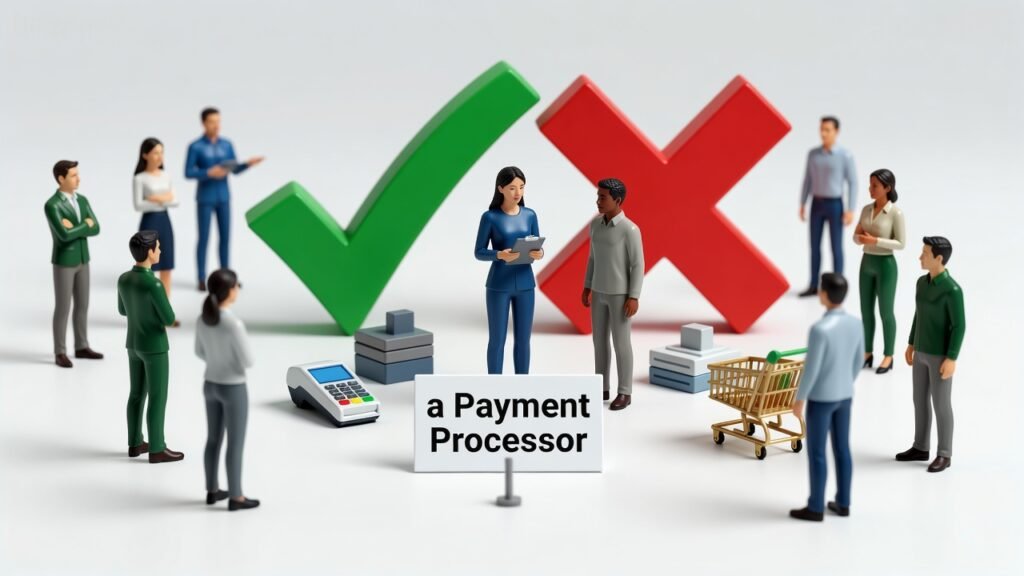
Calling checkout a payment processor conflates two distinct roles. The checkout is the payment experience; the processor is the transaction infrastructure. A checkout page alone cannot authorize a card, communicate with a bank, or settle funds. Without a processor connected to it, a checkout form has nowhere to send data that results in a completed payment.
The confusion arises because modern vendors increasingly market checkout as a payment product that bundles all these layers invisibly. When a merchant signs up for Stripe Checkout, they receive both a checkout interface and Stripe’s full processing infrastructure under one account. The checkout and the processing are technically distinct components within Stripe, but the merchant never configures them separately. This bundling is convenient but obscures what each layer actually does and who is responsible for it.
The practical rule for buyers: if a vendor’s checkout product requires a separate merchant account or a separate processing contract, the checkout is not itself a payment processor and those gaps must be filled independently. If the vendor supplies a single contract covering data capture through to settlement, the product qualifies as an all-in-one payment solution, even if the word “checkout” appears prominently in the product name.
Checkout.com: One Vendor, Multiple Layers
Checkout.com is a payment service provider that covers payment gateway services, payment processing, acquiring, fraud detection, and local payment methods through one integration. It is not merely a checkout tool or merely a standalone processor; it operates across multiple layers of the payment stack simultaneously. Checkout.com’s Hosted Payment Pages provide a prebuilt customer-facing interface, while its processing infrastructure handles authorization and settlement separately within the broader platform.
Checkout.com targets businesses with international ecommerce payment needs, multiple currencies, alternative payment methods, and enterprise-grade infrastructure requirements. Its direct acquiring relationships in multiple markets give it a meaningful advantage for merchants processing a high share of cross-border transactions, where local processing can improve authorization rates compared to routing everything through a single geography. Pricing is not published as a standard self-serve rate card; prospective merchants must request a quote and compare transaction fees, cross-border costs, currency conversion charges, and any chargeback or refund fees against competing PSPs before committing.
A smaller merchant looking for a quick, transparent setup with a publicly listed per-transaction price will find Checkout.com less immediately accessible than Stripe or PayPal. The platform is built for businesses that need granular routing controls, global coverage, and direct acquiring relationships, not for stores making their first hundred sales. Buyers evaluating Checkout.com should treat it as a full payment infrastructure decision rather than a checkout widget selection.
Which Checkout Tools Bundle Payment Processing?
The distinction between checkout interface and payment processing becomes concrete when reviewing which vendors bundle both functions and which require separate contracts. Knowing which category a tool falls into before signing up prevents integration gaps and unexpected compliance obligations.
Stripe Checkout and Stripe Payments both use Stripe’s own processing infrastructure, so signing up gives the merchant gateway and processing coverage in the same account. PayPal Checkout includes PayPal’s own processing, resolving the checkout as a payment processor relationship in a single contract. Square Online Checkout, Shopify Payments, and WooCommerce Payments all follow the same pattern: the checkout and the processing are handled by the same vendor under one agreement, with publicly listed per-transaction pricing and no separate merchant account required.
Braintree, owned by PayPal, provides a gateway and processing infrastructure that developers integrate at a lower level than a standard hosted page, giving more control over the checkout experience while still supplying full processing. Adyen Checkout is positioned similarly to Checkout.com: a platform with direct acquiring and processing capabilities aimed at larger merchants who need payment orchestration and regional payment method coverage. Authorize.net is primarily a standalone gateway; it connects a merchant’s checkout to a separate merchant account and processor, meaning a buyer using Authorize.net must arrange processing separately unless they use it through a bundled bank program, which adds a second vendor relationship to manage.
| Tool | Hosted Checkout UI | Gateway Included | Processing Included | All-in-One PSP | Pricing Model |
|---|---|---|---|---|---|
| Checkout.com | Yes | Yes | Yes | Yes | Custom quote |
| Stripe Checkout | Yes | Yes | Yes | Yes | Per-transaction, public |
| PayPal Checkout | Yes | Yes | Yes | Yes | Per-transaction, public |
| Square Online Checkout | Yes | Yes | Yes | Yes | Per-transaction, public |
| Adyen Checkout | Yes | Yes | Yes | Yes | Custom quote |
| Braintree | API/SDK | Yes | Yes | Yes | Per-transaction, public |
| Shopify Payments | Native to Shopify | Yes | Yes | Yes | Plan-based plus per-transaction |
| WooCommerce Payments | Native to WooCommerce | Yes | Yes | Yes | Per-transaction, public |
| Authorize.net | Hosted page option | Yes | Requires separate merchant account | No | Monthly fee plus per-transaction |
How to Choose the Right Setup for Your Store
Buyer Persona: A mid-size ecommerce operator processing a growing share of international orders is seeing more card declines on cross-border transactions than on domestic ones. They are comparing vendors to understand whether the issue sits at the checkout layer, the gateway layer, or the processing layer, and whether consolidating to a single vendor covering all three would resolve the problem without a costly replatforming effort.
For this operator, cross-border declines are a processor-layer issue. Consolidating to a PSP with direct local acquiring in target markets, such as Checkout.com or Adyen, is the structural fix. A checkout or gateway change alone will not resolve the underlying routing and acquiring gaps.
For most new and growing ecommerce stores, an all-in-one PSP that bundles checkout, a payment gateway, and processing in a single integration is the practical starting point. Stripe, PayPal, Square, Shopify Payments, and WooCommerce Payments all give merchants a single contract, a single support contact, and a single dashboard. The trade-off is less control over individual layers and, for high-volume sellers, limited ability to negotiate components separately or switch one layer independently of the others.
Checkout.com or Adyen become the stronger fit when at least two of the following apply: the store processes a significant share of international orders and cross-border decline rates are affecting revenue; monthly volume is large enough to justify custom fee negotiations; the business needs local payment methods in multiple regions that standard PSPs do not cover natively; or the engineering team can handle a more complex integration in exchange for deeper routing control. Stripe suits stores that want a public rate card, fast onboarding, and a large developer ecosystem without custom contract terms. PayPal adds conversion value in markets where buyer wallet recognition is a meaningful factor alongside card acceptance.
Quick Takeaways
- A checkout is the data-collection interface; a payment processor authorizes transactions and routes funds. They are distinct roles that some vendors happen to combine.
- All-in-one PSPs such as Stripe, PayPal, Square, Shopify Payments, and WooCommerce Payments bundle gateway and processing in a single account with public per-transaction pricing.
- Checkout.com and Adyen target merchants requiring direct acquiring, global local payment methods, and negotiated fees at meaningful transaction volume.
- Authorize.net is a gateway product that still requires a separate merchant account and processing arrangement for most buyers.
- Buyers should confirm which layers a vendor covers before signing any agreement, since a product named “Checkout” does not guarantee full processing is included.
Frequently Asked Questions
- Does a checkout page process payments by itself?
- A checkout page captures and transmits payment data but cannot complete a financial transaction on its own. It requires a connected payment gateway to encrypt and route that data and a payment processor to communicate with card networks and issuing banks. Without those backend layers in place, the checkout form has no path to authorization or fund settlement.
- Is Checkout.com a payment processor or a payment gateway?
- Checkout.com functions as a full-stack payment service provider rather than a standalone gateway or processor in isolation. Its platform bundles acquiring, fraud tooling, and regional payment methods alongside both gateway and processing capabilities, all accessible through one merchant account. Because pricing is negotiated rather than published, any merchant comparing it against other PSPs needs to request a custom quote to evaluate total transaction costs.
- Do Stripe Checkout and Stripe Payments include payment processing?
- Both Stripe Checkout and Stripe Payments draw on Stripe’s own processing infrastructure, so a merchant who signs up for either product receives gateway and processing coverage within the same account. The checkout interface and the processing engine are technically separate components inside Stripe, but they are sold and supported as a single bundled product with publicly listed per-transaction fees.
- Is PayPal Checkout a payment processor?
- PayPal Checkout bundles PayPal’s own processing infrastructure, making it an all-in-one payment solution for merchants who accept it. The checkout interface and the processing layer are both provided by PayPal under a single account, removing the need for a separate processor contract. Standard transaction pricing is listed publicly on PayPal’s pricing page with no monthly minimum for most accounts.
- What is the difference between a merchant account and a payment processor?
- A merchant account is a specialized bank account that holds authorized funds before they transfer to a business’s main account. A payment processor is the service that runs authorization requests and routes funds through card networks. Modern all-in-one PSPs aggregate merchant funds in pooled accounts, which removes the requirement for each merchant to open a dedicated merchant account independently.
- Which ecommerce checkout tools include payment processing?
- Stripe Checkout, PayPal Checkout, Square Online Checkout, Shopify Payments, WooCommerce Payments, Braintree, Adyen Checkout, and Checkout.com all include payment processing within the same product. Authorize.net is the notable exception among widely used tools: it provides gateway services but requires merchants to arrange a separate merchant account and processing contract to complete the payment stack.